🚚 Free Worldwide Shipping on All Orders!Shop Now

Northanger Abbey
6b Jane Austen. London: Blackie & Son, ca. 1895.
Notes
Northanger Abbey serves as Jane Austen’s foundational coming-of-age novel and a brilliant, layered satire of the late 18th-century Gothic literary craze. The plot centers on Catherine Morland, a sheltered, imaginative 17-year-old country clergyman's daughter who enters the fashionable, competitive social world of Bath. An avid reader of melodramatic Gothic romances—specifically Ann Radcliffe's The Mysteries of Udolpho—Catherine begins to comically mistake real-life events for dark, sinister conspiracies. Upon being invited to Northanger Abbey, the ancestral estate of her love interest, Henry Tilney, her overactive imagination reaches a fever pitch as she imagines murder and hidden secrets behind every locked door. Ultimately, Catherine suffers a series of painful social mortifications that force her to shed her literary delusions. Through this journey, Austen deftly transitions her protagonist from a naive girl "in training for a heroine" into a mature young woman capable of distinguishing fictional melodrama from actual human deception.
Though published posthumously in December 1817 (with the title page carrying the date 1818), Northanger Abbey holds a unique place in the Austen canon as her first completed full-length manuscript. Originally drafted between 1798 and 1799 under the working title Susan, Austen sold the manuscript to London publisher Benjamin Crosby in 1803 for £10. However, Crosby left the book unpublished in his vaults, forcing Austen’s brother, Henry, to buy back the copyright a year before the author's death. Austen's prose throughout the work is uniquely energetic and joyful, showcasing an early mastery of free indirect discourse, sharp irony, and cutting social observation. Alongside the core romance, the novel contains a famous, passionate authorial defense of fiction. Austen explicitly rejects the era's cultural snobbery toward novels, proudly declaring the medium to be a work in which the "greatest powers of the mind" are thoroughly
This 1895 volume emerged during a monumental, transformative era for Austen’s legacy. While her works were luxury, low-print-run items during her own lifetime, the late 19th century witnessed an explosion of interest. This revival transformed her status from a minor Regency writer into a canonized giant of English literature. The late-Victorian publisher Blackie & Son capitalized on this booming market by issuing affordable yet beautifully bound single-volume classics to satisfy a newly literate, expanding middle-class audience. This specific period also marks the dawn of the Arts and Crafts and Art Nouveau movements in British book design. Notably, Blackie & Son's Glasgow headquarters was under the art direction of Talwin Morris at this exact time, an era famous for pioneering highly stylized, organic cover graphics.
Description
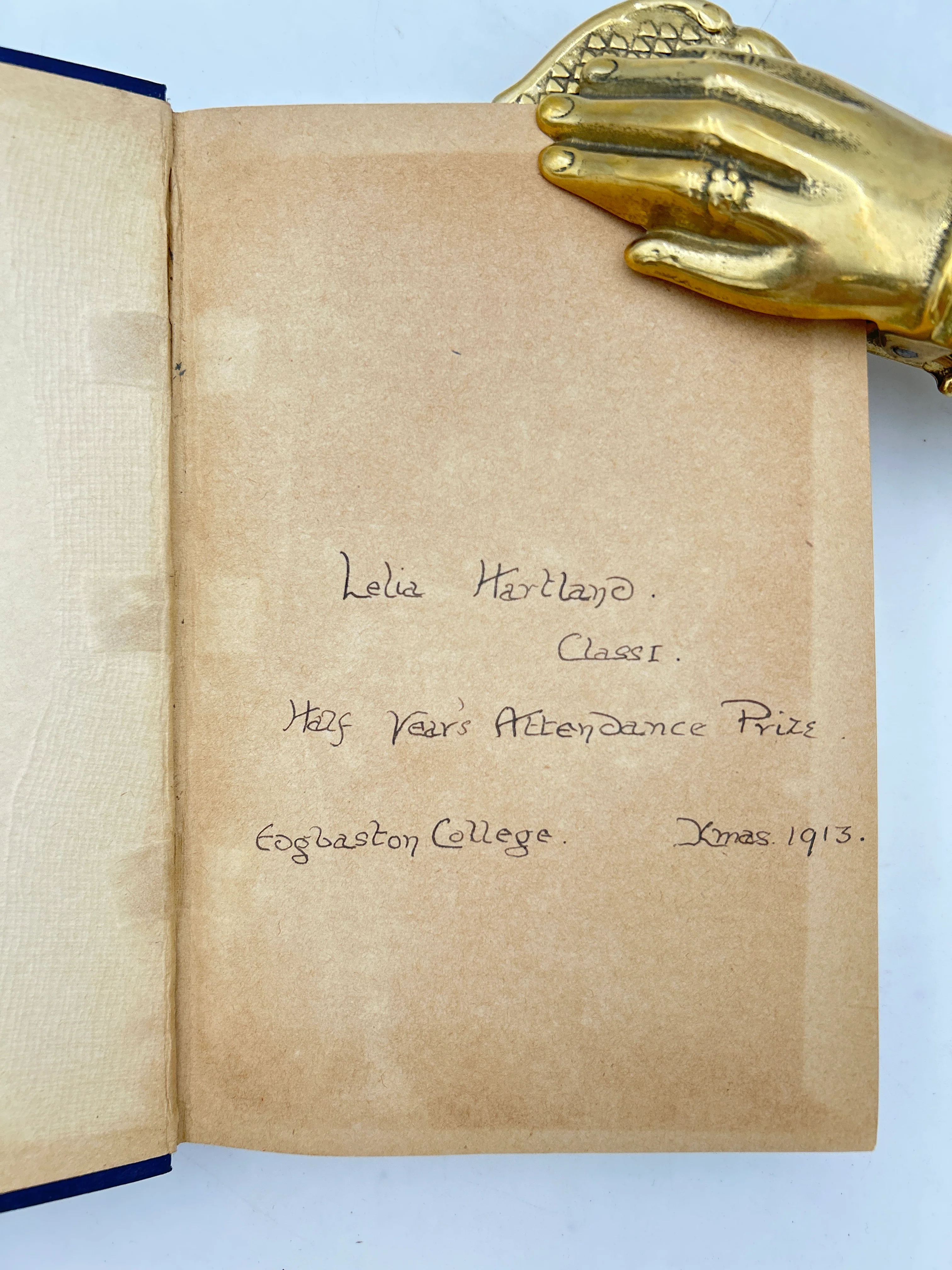
Navy blue cloth binding with orange flowers and lettering to upper board and spine. Gilt crest and lettering on the lower board of Edgbaston College for Girls, Bristol Road. Some foxing to preliminary pages then keeps to the margins. Sunfading to spine. Handwritten inscription on preliminary flyleaf noting that this book was gifted to Lelia Hartland for an Attendance prize at the aforementioned college dated ‘Xmas 1913.’ Very good condition overall.
$138.25
Original: $395.00
-65%Northanger Abbey—
$395.00
$138.25




Description
6b Jane Austen. London: Blackie & Son, ca. 1895.
Notes
Northanger Abbey serves as Jane Austen’s foundational coming-of-age novel and a brilliant, layered satire of the late 18th-century Gothic literary craze. The plot centers on Catherine Morland, a sheltered, imaginative 17-year-old country clergyman's daughter who enters the fashionable, competitive social world of Bath. An avid reader of melodramatic Gothic romances—specifically Ann Radcliffe's The Mysteries of Udolpho—Catherine begins to comically mistake real-life events for dark, sinister conspiracies. Upon being invited to Northanger Abbey, the ancestral estate of her love interest, Henry Tilney, her overactive imagination reaches a fever pitch as she imagines murder and hidden secrets behind every locked door. Ultimately, Catherine suffers a series of painful social mortifications that force her to shed her literary delusions. Through this journey, Austen deftly transitions her protagonist from a naive girl "in training for a heroine" into a mature young woman capable of distinguishing fictional melodrama from actual human deception.
Though published posthumously in December 1817 (with the title page carrying the date 1818), Northanger Abbey holds a unique place in the Austen canon as her first completed full-length manuscript. Originally drafted between 1798 and 1799 under the working title Susan, Austen sold the manuscript to London publisher Benjamin Crosby in 1803 for £10. However, Crosby left the book unpublished in his vaults, forcing Austen’s brother, Henry, to buy back the copyright a year before the author's death. Austen's prose throughout the work is uniquely energetic and joyful, showcasing an early mastery of free indirect discourse, sharp irony, and cutting social observation. Alongside the core romance, the novel contains a famous, passionate authorial defense of fiction. Austen explicitly rejects the era's cultural snobbery toward novels, proudly declaring the medium to be a work in which the "greatest powers of the mind" are thoroughly
This 1895 volume emerged during a monumental, transformative era for Austen’s legacy. While her works were luxury, low-print-run items during her own lifetime, the late 19th century witnessed an explosion of interest. This revival transformed her status from a minor Regency writer into a canonized giant of English literature. The late-Victorian publisher Blackie & Son capitalized on this booming market by issuing affordable yet beautifully bound single-volume classics to satisfy a newly literate, expanding middle-class audience. This specific period also marks the dawn of the Arts and Crafts and Art Nouveau movements in British book design. Notably, Blackie & Son's Glasgow headquarters was under the art direction of Talwin Morris at this exact time, an era famous for pioneering highly stylized, organic cover graphics.
Description
Navy blue cloth binding with orange flowers and lettering to upper board and spine. Gilt crest and lettering on the lower board of Edgbaston College for Girls, Bristol Road. Some foxing to preliminary pages then keeps to the margins. Sunfading to spine. Handwritten inscription on preliminary flyleaf noting that this book was gifted to Lelia Hartland for an Attendance prize at the aforementioned college dated ‘Xmas 1913.’ Very good condition overall.