🚚 Free Worldwide Shipping on All Orders!Shop Now

Les Miserables
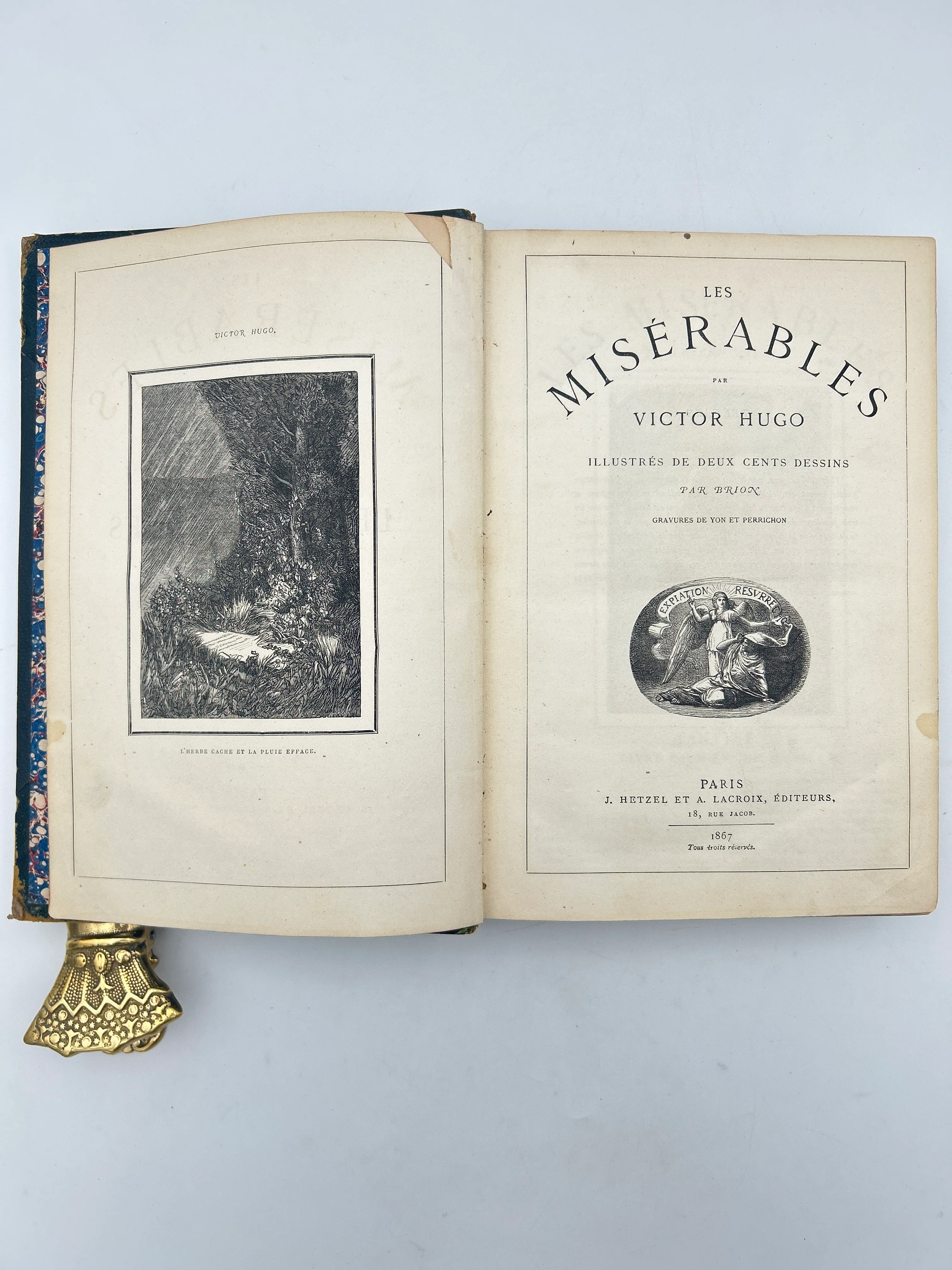
6b Victor Hugo. Paris: J. Hetzel et A. Lacroix, 1867. In French.
Notes
Set against the turbulent sociopolitical landscape of early 19th-century France—culminating in the bloody June Rebellion of 1832—Les Misérables is a monumental epic tracking the agonizing path toward spiritual and societal redemption. The narrative follows Jean Valjean, an honest peasant condemned to nineteen years of brutal hard labor for stealing a loaf of bread to feed his starving family. Transformed into a hardened cynic by the penal system, Valjean experiences a profound moral awakening after an act of radical mercy by the saintly Bishop Myriel. Under a series of assumed identities, Valjean rises to prosperity, dedicating his life to shielding the vulnerable—most notably Cosette, the orphaned daughter of the doomed seamstress Fantine. However, Valjean is relentlessly hunted across decades by Inspector Javert, a cold, fanatical embodiment of rigid, unyielding legalism. Interweaving romance, historical dissertation, and revolutionary warfare, Hugo explores the crushing weight of systemic poverty, the corrupting nature of absolute law, and the ultimate triumph of divine grace over human injustice.
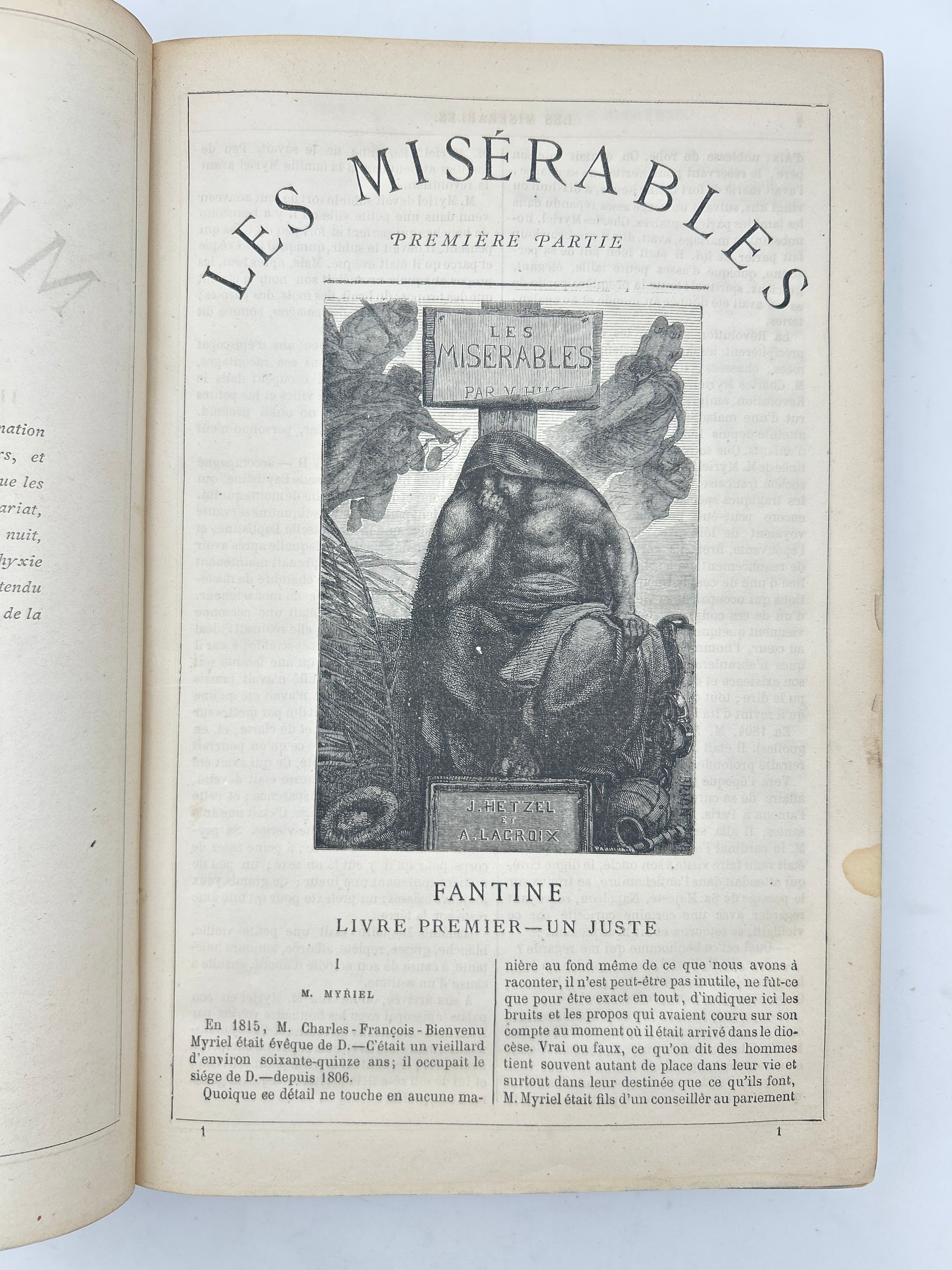
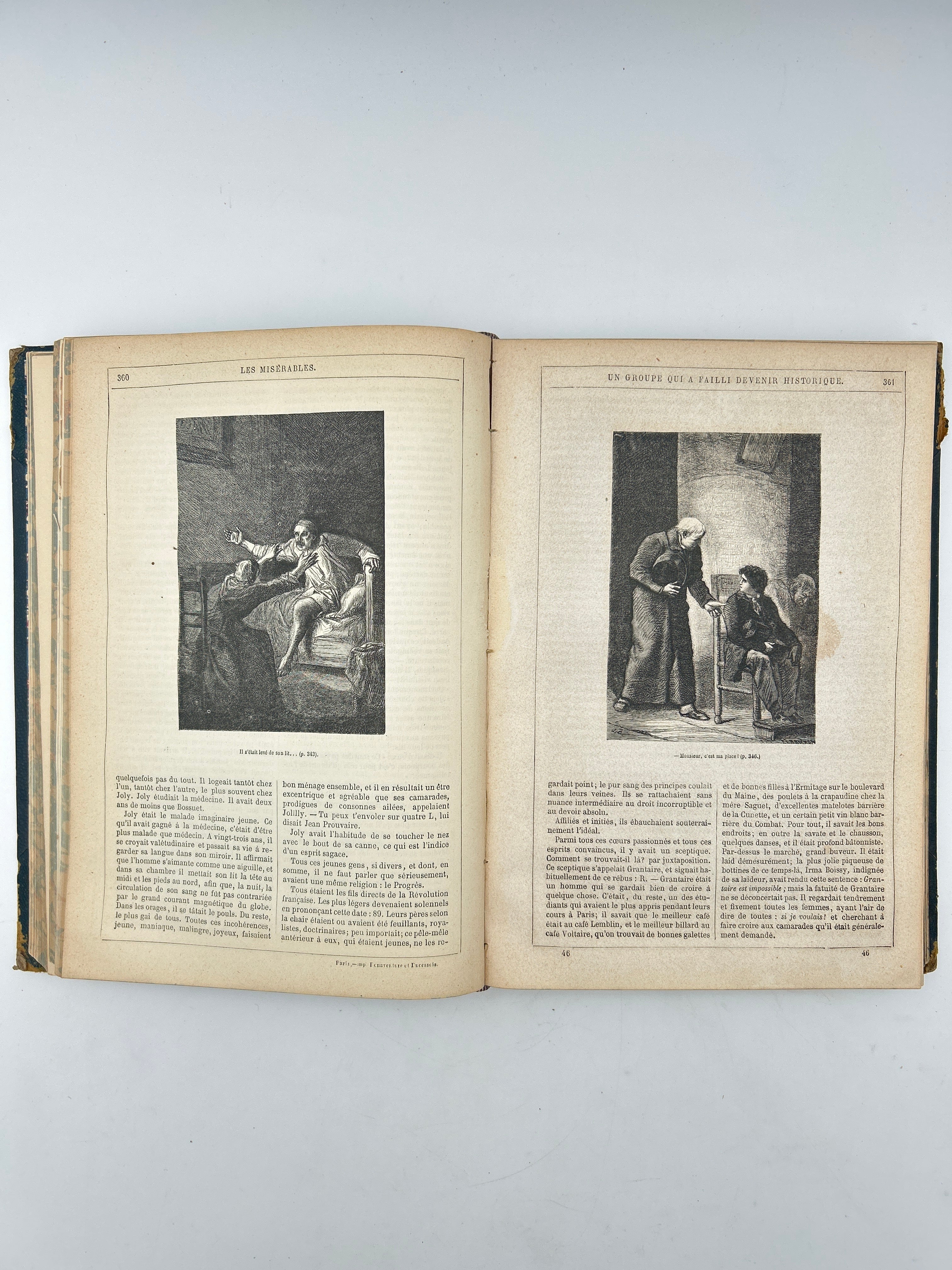
Victor Hugo spent nearly two decades conceptualizing and writing this monolithic masterpiece, completing it while living in political exile on the island of Guernsey due to his fierce opposition to Napoleon III. The novel was first published in Brussels by Albert Lacroix in 1862, instantly becoming an international sensation that shook the global literary establishment. This specific 1867 printing represents a critical milestone in the book's lifespan: the union of Lacroix with the legendary publisher Pierre-Jules Hetzel. Hetzel, famously known as the visionary publisher of Jules Verne's sci-fi odysseys, specialized in creating high-quality, beautifully designed popular editions. For this volume, they utilized the artwork of Gustave Brion, whose dark, atmospheric, and emotionally expressive illustrations were personally approved by Hugo as the truest visual representations of his characters.
The 1867 Hetzel & Lacroix edition arrived at a vital moment in French history, hitting Parisian bookshops during the height of the Second French Empire, just as working-class unrest was beginning to boil over once more. By pairing Hugo's radical, anti-establishment social critique with Brion's vivid, accessible wood engravings, Hetzel and Lacroix democratized Les Misérables, moving it out of exclusive upper-class private libraries and directly into the hands of the expanding French middle and literate working classes. Today, this 1867 illustrated edition stands as a magnificent artifact from the golden age of French wood engraving, capturing a timeless masterpiece precisely as it was solidifying its status as an immortal monument of French national heritage.
Description
pebbled leather covered boards and three-quarter black leather. Marbled endpapers. Spines decorated in gilt. Lavishly illustrated with nearly 200 striking in-text wood engravings and full-page plates primarily drawn by Gustave Brion and engraved by Yon and Perrichon. Rubbing down to corners of black leather along edges and points and spine hinges. Slightly knocked spine but fully intact. Marbled edges. Closed tear ro fist two leaves. Tear to 297-304. Two ownership bookplate pastedowns to interior board. Good condition overall.
First Hetzel Illustrated Edition (often cited as the definitive early single-volume or compact multi-part popular illustrated issue). In French.
$525.00
Original: $1,500.00
-65%Les Miserables—
$1,500.00
$525.00


Description
6b Victor Hugo. Paris: J. Hetzel et A. Lacroix, 1867. In French.
Notes
Set against the turbulent sociopolitical landscape of early 19th-century France—culminating in the bloody June Rebellion of 1832—Les Misérables is a monumental epic tracking the agonizing path toward spiritual and societal redemption. The narrative follows Jean Valjean, an honest peasant condemned to nineteen years of brutal hard labor for stealing a loaf of bread to feed his starving family. Transformed into a hardened cynic by the penal system, Valjean experiences a profound moral awakening after an act of radical mercy by the saintly Bishop Myriel. Under a series of assumed identities, Valjean rises to prosperity, dedicating his life to shielding the vulnerable—most notably Cosette, the orphaned daughter of the doomed seamstress Fantine. However, Valjean is relentlessly hunted across decades by Inspector Javert, a cold, fanatical embodiment of rigid, unyielding legalism. Interweaving romance, historical dissertation, and revolutionary warfare, Hugo explores the crushing weight of systemic poverty, the corrupting nature of absolute law, and the ultimate triumph of divine grace over human injustice.
Victor Hugo spent nearly two decades conceptualizing and writing this monolithic masterpiece, completing it while living in political exile on the island of Guernsey due to his fierce opposition to Napoleon III. The novel was first published in Brussels by Albert Lacroix in 1862, instantly becoming an international sensation that shook the global literary establishment. This specific 1867 printing represents a critical milestone in the book's lifespan: the union of Lacroix with the legendary publisher Pierre-Jules Hetzel. Hetzel, famously known as the visionary publisher of Jules Verne's sci-fi odysseys, specialized in creating high-quality, beautifully designed popular editions. For this volume, they utilized the artwork of Gustave Brion, whose dark, atmospheric, and emotionally expressive illustrations were personally approved by Hugo as the truest visual representations of his characters.
The 1867 Hetzel & Lacroix edition arrived at a vital moment in French history, hitting Parisian bookshops during the height of the Second French Empire, just as working-class unrest was beginning to boil over once more. By pairing Hugo's radical, anti-establishment social critique with Brion's vivid, accessible wood engravings, Hetzel and Lacroix democratized Les Misérables, moving it out of exclusive upper-class private libraries and directly into the hands of the expanding French middle and literate working classes. Today, this 1867 illustrated edition stands as a magnificent artifact from the golden age of French wood engraving, capturing a timeless masterpiece precisely as it was solidifying its status as an immortal monument of French national heritage.
Description
pebbled leather covered boards and three-quarter black leather. Marbled endpapers. Spines decorated in gilt. Lavishly illustrated with nearly 200 striking in-text wood engravings and full-page plates primarily drawn by Gustave Brion and engraved by Yon and Perrichon. Rubbing down to corners of black leather along edges and points and spine hinges. Slightly knocked spine but fully intact. Marbled edges. Closed tear ro fist two leaves. Tear to 297-304. Two ownership bookplate pastedowns to interior board. Good condition overall.
First Hetzel Illustrated Edition (often cited as the definitive early single-volume or compact multi-part popular illustrated issue). In French.