🚚 Free Worldwide Shipping on All Orders!Shop Now

Helen Keller’s Journal
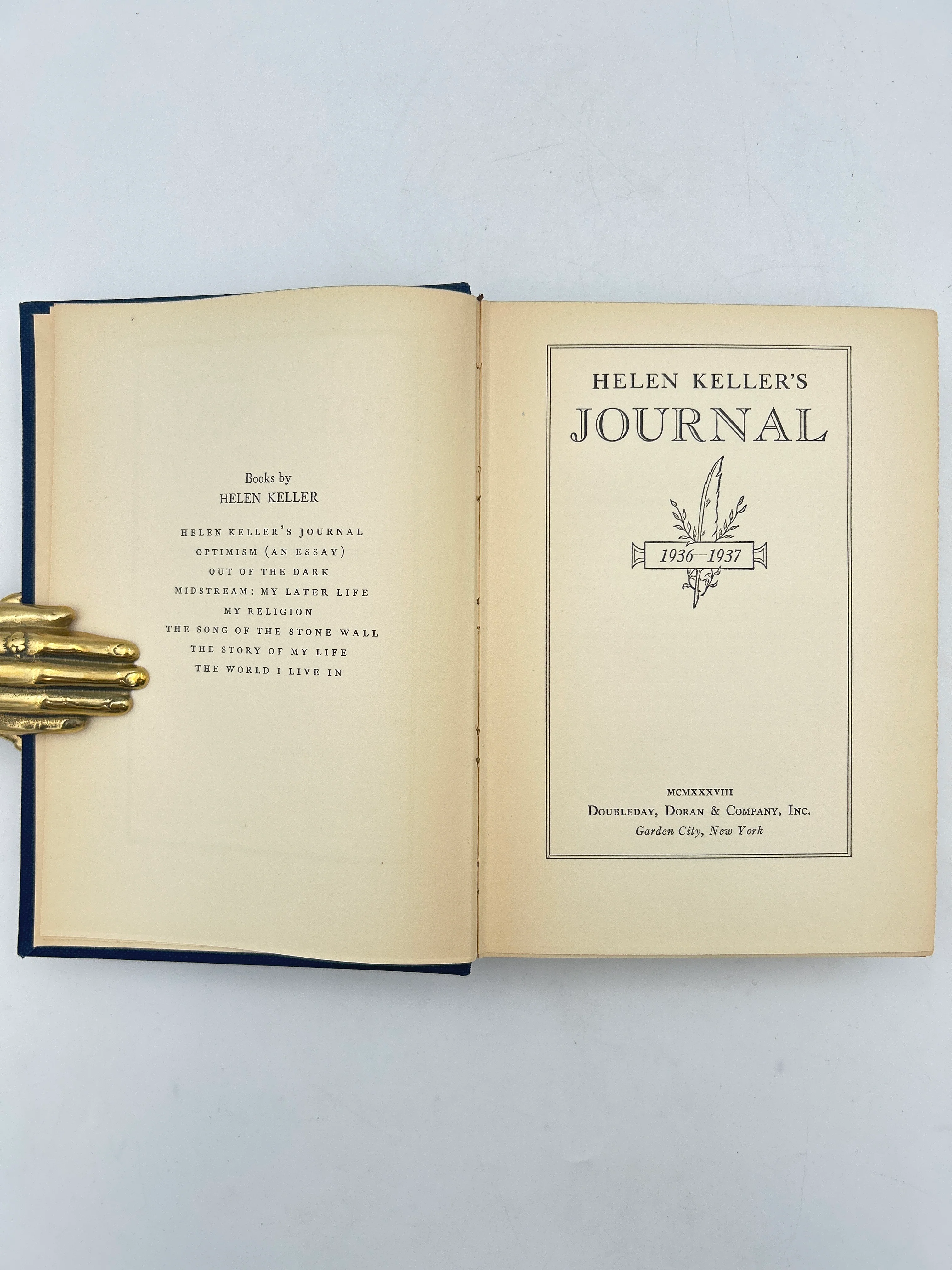
6b Helen Keller. New York: Doubleday, Doran & Company, 1938. First Edition. SIGNED.
Notes
Helen Keller’s Journal is a remarkably raw, poignant, and deeply introspective autobiographical work that captures one of the most painful transitional phases of the author's life. Spanning the months between November 1936 and December 1937, the text records Keller’s profound grief following the death of her lifelong teacher and companion Anne Sullivan Macy, who passed away in October 1936. Rather than collapsing under the weight of her isolation, Keller utilizes the journal format to process her sorrow as she travels through Great Britain, Europe, and Japan. The book provides an astonishingly intimate look into her inner landscape, her continued political advocacy for blind and injured workers, and her efforts to maintain independence alongside her remaining companion, Polly Thomson.
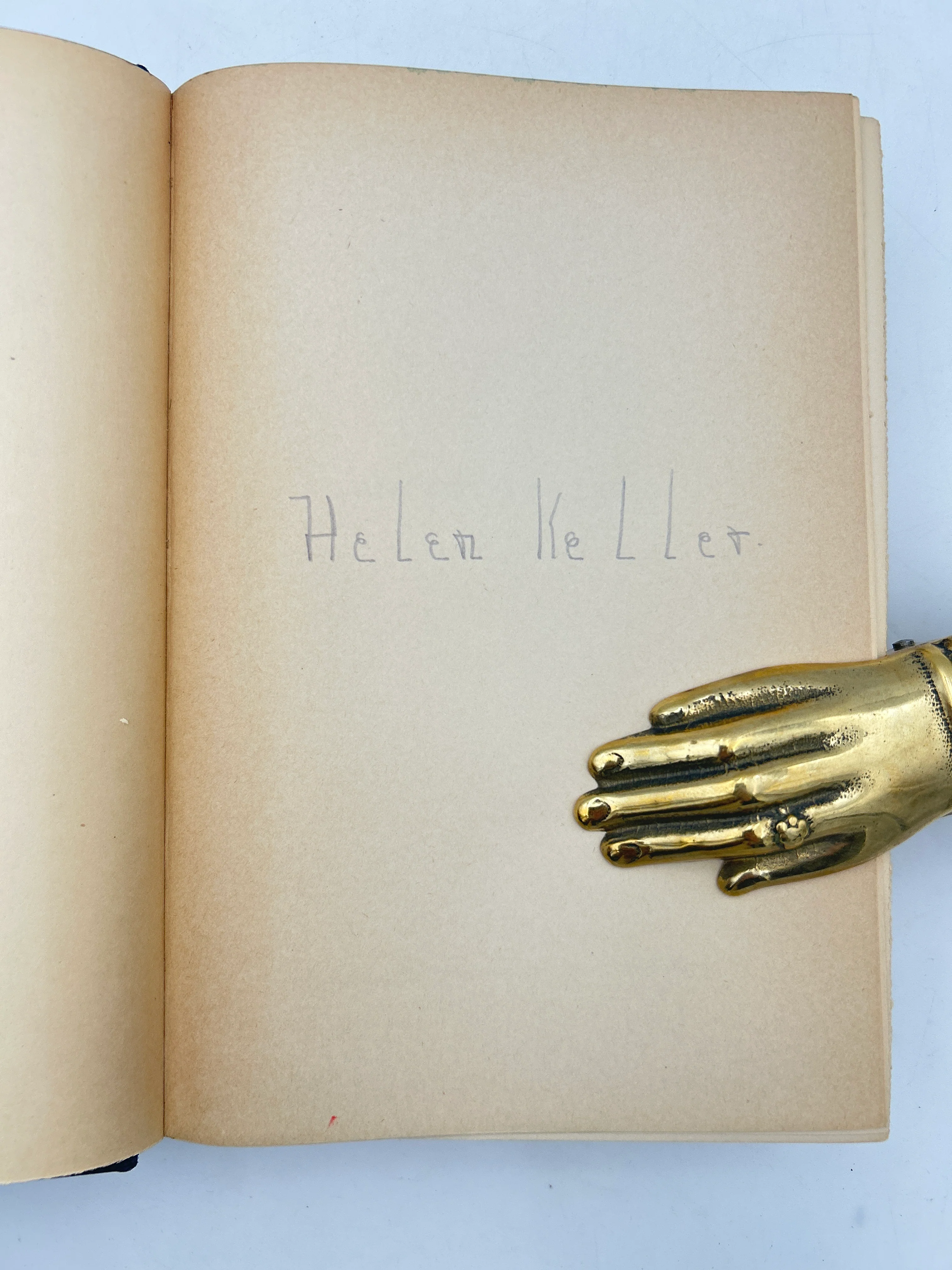
The presence of Helen Keller's physical autograph on this volume provides an incredible, tactile connection to the unique educational methods she pioneered. Because she was deaf and blind, the act of writing required an extraordinary mastery of assistive technology and muscle memory. While she relied heavily on Braille typewriters and standard tactile typing for book composition, her manual script—known historically as "Square Hand" writing—remains a marvel of early special education.
To sign books and write correspondence, Keller utilized a specialized grooved writing board developed at the Perkins School for the Blind. A sheet of paper was placed over this metal or wooden board and gently creased into parallel, horizontal grooves. Keller used these physical indentations as a strict tactile frame. Guiding the pencil with her right hand, she traced the lowercase elements of her letters perfectly against the straight edge of the lower groove, while using the forefinger of her left hand to track spaces and prevent overlapping. Because she could not see standard cursive loops, she systematically memorized the geometric shapes of block-style printing. This technique gave her signature its iconic, sharply upright, calligraphic straight edges.
Published on the eve of World War II, this 1938 volume marked a critical shift in how the global public viewed Keller. It transitioned her legacy from an inspiring, idealized child prodigy into a mature, internationally recognized intellectual and socio-political force. Doubleday, Doran produced the book to high pre-war typography standards, but due to its release during the tail end of the Great Depression, commercial print runs were modest. While unsigned copies appear occasionally in the antiquarian trade, copies signed directly by Keller in her signature pencil are exceptionally scarce and highly coveted.
Description
Hardcover bound in blue cloth-covered boards. Deckled edges. Saint toning to the leaves. Absent dust jacket. ‘H.K’ in gilt on upper board and to white label on spine. Very fine condition. Signature to second blank flyleaf.
$437.50
Original: $1,250.00
-65%Helen Keller’s Journal—
$1,250.00
$437.50


Description
6b Helen Keller. New York: Doubleday, Doran & Company, 1938. First Edition. SIGNED.
Notes
Helen Keller’s Journal is a remarkably raw, poignant, and deeply introspective autobiographical work that captures one of the most painful transitional phases of the author's life. Spanning the months between November 1936 and December 1937, the text records Keller’s profound grief following the death of her lifelong teacher and companion Anne Sullivan Macy, who passed away in October 1936. Rather than collapsing under the weight of her isolation, Keller utilizes the journal format to process her sorrow as she travels through Great Britain, Europe, and Japan. The book provides an astonishingly intimate look into her inner landscape, her continued political advocacy for blind and injured workers, and her efforts to maintain independence alongside her remaining companion, Polly Thomson.
The presence of Helen Keller's physical autograph on this volume provides an incredible, tactile connection to the unique educational methods she pioneered. Because she was deaf and blind, the act of writing required an extraordinary mastery of assistive technology and muscle memory. While she relied heavily on Braille typewriters and standard tactile typing for book composition, her manual script—known historically as "Square Hand" writing—remains a marvel of early special education.
To sign books and write correspondence, Keller utilized a specialized grooved writing board developed at the Perkins School for the Blind. A sheet of paper was placed over this metal or wooden board and gently creased into parallel, horizontal grooves. Keller used these physical indentations as a strict tactile frame. Guiding the pencil with her right hand, she traced the lowercase elements of her letters perfectly against the straight edge of the lower groove, while using the forefinger of her left hand to track spaces and prevent overlapping. Because she could not see standard cursive loops, she systematically memorized the geometric shapes of block-style printing. This technique gave her signature its iconic, sharply upright, calligraphic straight edges.
Published on the eve of World War II, this 1938 volume marked a critical shift in how the global public viewed Keller. It transitioned her legacy from an inspiring, idealized child prodigy into a mature, internationally recognized intellectual and socio-political force. Doubleday, Doran produced the book to high pre-war typography standards, but due to its release during the tail end of the Great Depression, commercial print runs were modest. While unsigned copies appear occasionally in the antiquarian trade, copies signed directly by Keller in her signature pencil are exceptionally scarce and highly coveted.
Description
Hardcover bound in blue cloth-covered boards. Deckled edges. Saint toning to the leaves. Absent dust jacket. ‘H.K’ in gilt on upper board and to white label on spine. Very fine condition. Signature to second blank flyleaf.