🚚 Free Worldwide Shipping on All Orders!Shop Now

Cannery Row
6b John Steinbeck. New York: The Viking Press, 1945. First issue, first edition.
Notes
Set against the gritty backdrop of a seaside strip in Monterey, California during the Great Depression, Cannery Row is a nostalgic, picaresque masterpiece populated by a colorful, tight-knit community of social outcasts. The episodic narrative revolves around the eccentric denizens of the Row: Mack and his resourceful band of benign vagrants living in a converted fish-flophouse; Lee Chong, the shrewd yet deeply compassionate Chinese grocer; Dora Flood, the generous, community-minded madam of the local brothel; and Doc, a brilliant, isolated marine biologist who serves as the intellectual and emotional anchor of the neighborhood. Rather than relying on a rigid, traditional plot, the novel unfolds through a series of interlocking vignettes centered around Mack and the boys' chaotic, well-meaning attempts to throw an elaborate surprise party for Doc. Through this uproariously funny yet deeply melancholic framework, Steinbeck crafts a profound philosophical tribute to community solidarity, loneliness, and the genuine beauty found in lives uncorrupted by mainstream societal greed.
Written during a period of intense personal upheaval and creative exhaustion while John Steinbeck was serving as a World War II war correspondent, Cannery Row was deliberately crafted as a nostalgic escape back to his beloved California roots. Released by The Viking Press in January 1945, the book is a deeply loving, thinly veiled fictionalization of Steinbeck's real-life experiences in Monterey. Most notably, the beloved character of Doc was directly modeled after Ed Ricketts, an pioneering marine biologist, ecological philosopher, and Steinbeck's closest intellectual mentor. Ricketts' real-life Pacific Biological Laboratories served as the primary setting for the book. Steinbeck’s prose seamlessly balances lighthearted, comedic farce with striking poetic interludes, capturing the sights, sounds, and heavy smells of the sardine canneries with absolute precision.
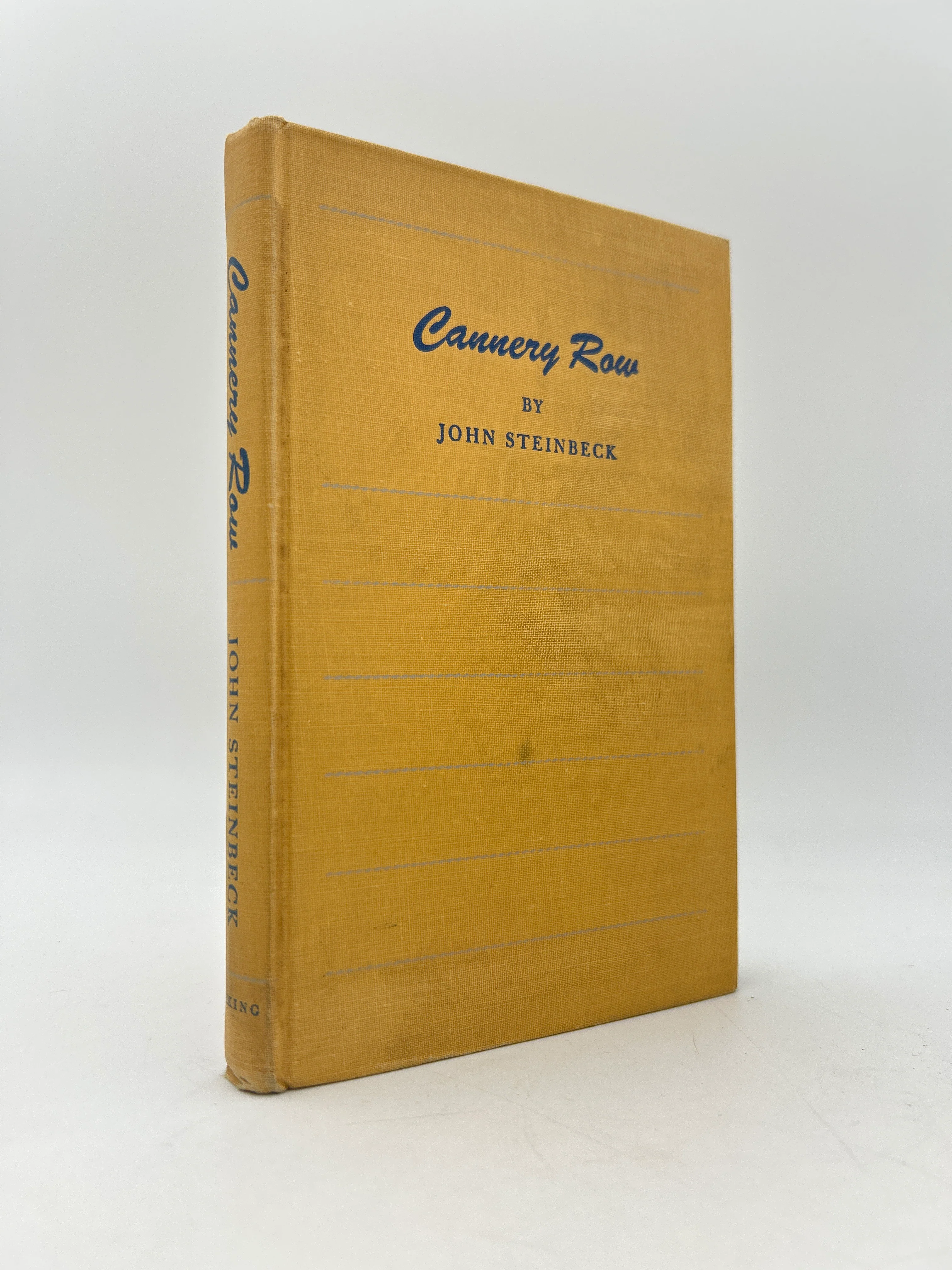
This 1945 volume stands as a crucial historical artifact of mid-century American publishing under the constraints of World War II. To comply with strict government wartime conservation measures, the book was printed on highly compressed, thin paper stocks, leading to its characteristic slim profile. Furthermore, these material shortages created a famous bibliographical point for collectors: the binders completely ran out of the original light-buff (tan) cloth midway through the initial first-printing run, forcing the publisher to finish the remainder of the first edition using a bright, canary-yellow cloth. Upon its release, the book's stark celebration of bums and madams deeply polarized conservative mid-century critics, yet it quickly became a massive commercial triumph. Today, Cannery Row is universally canonized as one of Steinbeck's finest achievements, celebrated for creating the template for the modern ensemble narrative and cementing the actual geographic strip in Monterey as an immortal landmark of American literary history.
Description
Yellow canvas binding with blue lettering on cover and spine. Some minimal scuffing to board. Original dust wrapper.
$525.00
Original: $1,500.00
-65%Cannery Row—
$1,500.00
$525.00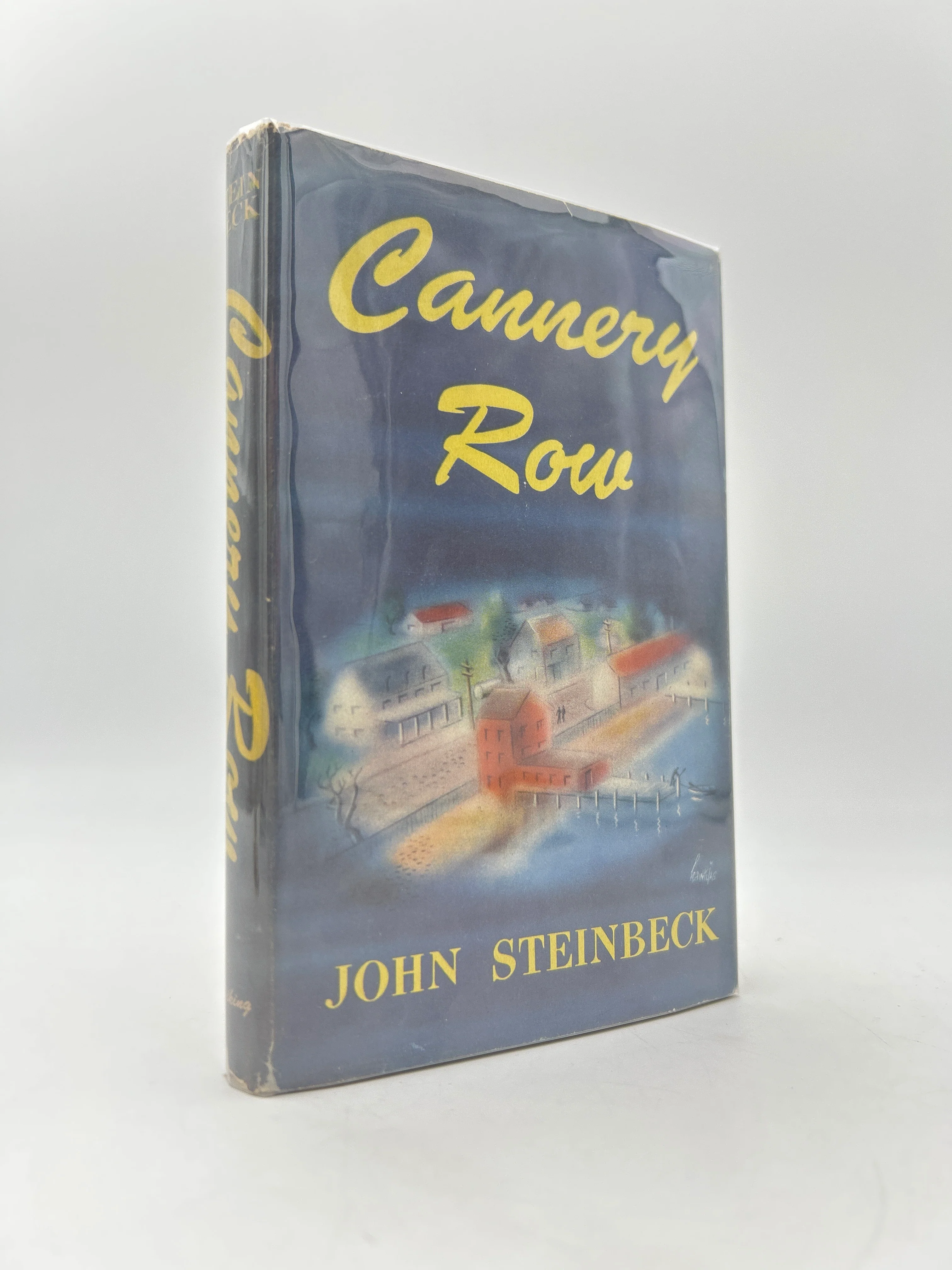


Description
6b John Steinbeck. New York: The Viking Press, 1945. First issue, first edition.
Notes
Set against the gritty backdrop of a seaside strip in Monterey, California during the Great Depression, Cannery Row is a nostalgic, picaresque masterpiece populated by a colorful, tight-knit community of social outcasts. The episodic narrative revolves around the eccentric denizens of the Row: Mack and his resourceful band of benign vagrants living in a converted fish-flophouse; Lee Chong, the shrewd yet deeply compassionate Chinese grocer; Dora Flood, the generous, community-minded madam of the local brothel; and Doc, a brilliant, isolated marine biologist who serves as the intellectual and emotional anchor of the neighborhood. Rather than relying on a rigid, traditional plot, the novel unfolds through a series of interlocking vignettes centered around Mack and the boys' chaotic, well-meaning attempts to throw an elaborate surprise party for Doc. Through this uproariously funny yet deeply melancholic framework, Steinbeck crafts a profound philosophical tribute to community solidarity, loneliness, and the genuine beauty found in lives uncorrupted by mainstream societal greed.
Written during a period of intense personal upheaval and creative exhaustion while John Steinbeck was serving as a World War II war correspondent, Cannery Row was deliberately crafted as a nostalgic escape back to his beloved California roots. Released by The Viking Press in January 1945, the book is a deeply loving, thinly veiled fictionalization of Steinbeck's real-life experiences in Monterey. Most notably, the beloved character of Doc was directly modeled after Ed Ricketts, an pioneering marine biologist, ecological philosopher, and Steinbeck's closest intellectual mentor. Ricketts' real-life Pacific Biological Laboratories served as the primary setting for the book. Steinbeck’s prose seamlessly balances lighthearted, comedic farce with striking poetic interludes, capturing the sights, sounds, and heavy smells of the sardine canneries with absolute precision.
This 1945 volume stands as a crucial historical artifact of mid-century American publishing under the constraints of World War II. To comply with strict government wartime conservation measures, the book was printed on highly compressed, thin paper stocks, leading to its characteristic slim profile. Furthermore, these material shortages created a famous bibliographical point for collectors: the binders completely ran out of the original light-buff (tan) cloth midway through the initial first-printing run, forcing the publisher to finish the remainder of the first edition using a bright, canary-yellow cloth. Upon its release, the book's stark celebration of bums and madams deeply polarized conservative mid-century critics, yet it quickly became a massive commercial triumph. Today, Cannery Row is universally canonized as one of Steinbeck's finest achievements, celebrated for creating the template for the modern ensemble narrative and cementing the actual geographic strip in Monterey as an immortal landmark of American literary history.
Description
Yellow canvas binding with blue lettering on cover and spine. Some minimal scuffing to board. Original dust wrapper.